Digital Twin: one management layer across your whole company
A Digital Twin is a management layer that connects the setup of your company, your performance and the current reality, so at any moment you can see what is going on and what a choice would mean. It does not come out of one big project, it grows out of separate applications: from about five tools or agents on the same digital foundation, the picture shifts from separate aids to one coherent whole. The sixth seat is the super agent sitting on top of that: it oversees everything, spots cross connections and prepares decisions. Deciding stays human work.
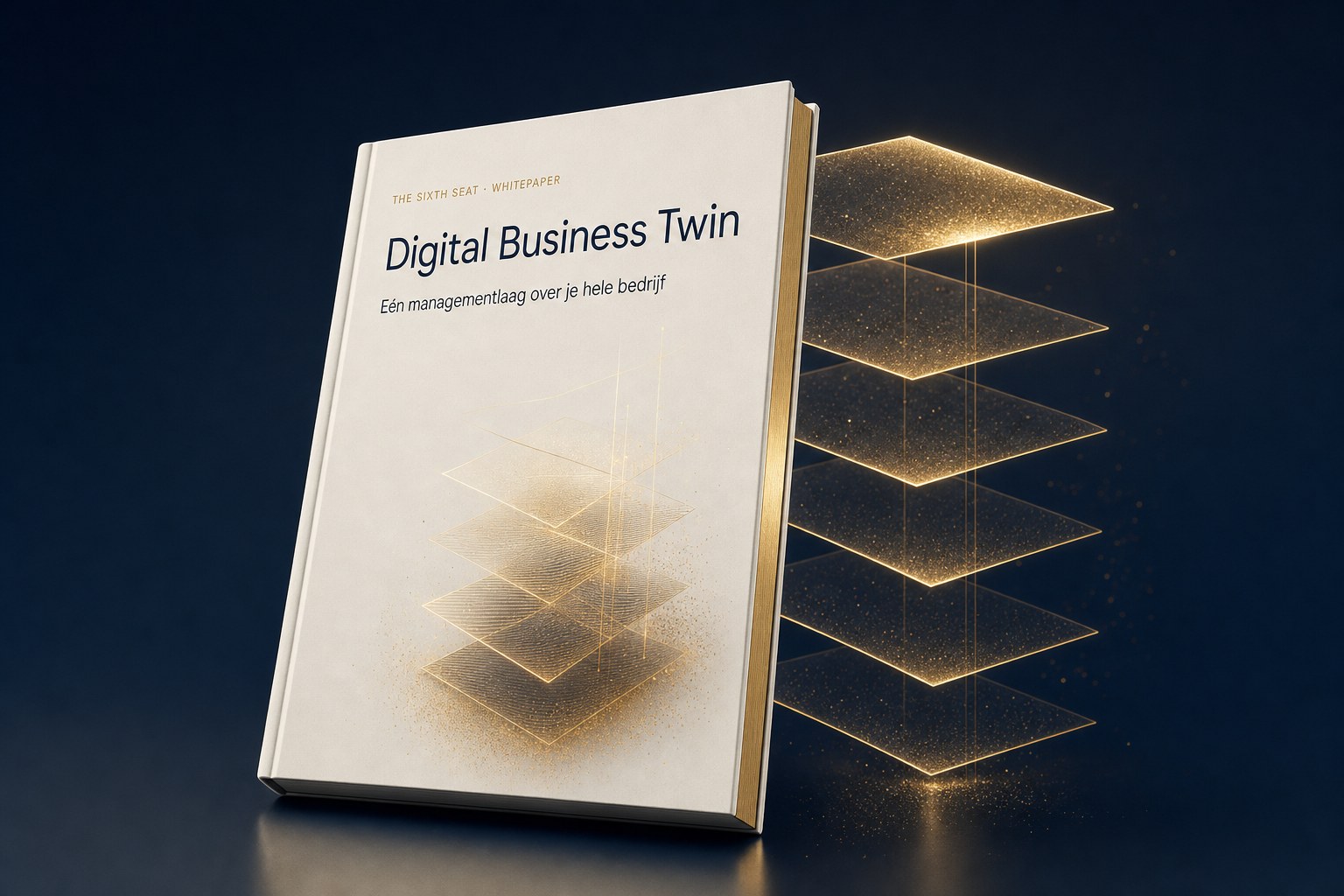
What is a Digital Twin?
A Digital Twin is a digital representation of how your company works, performs and stands today, brought together in one layer above your existing systems. Three things come together in it.
- Setup. How your company is put together: customers, products, projects, departments, processes, contracts, rules and mandates. This is the skeleton.
- Performance. What actually happens: revenue, margin, hours, lead times, inventory, payment behavior, quality, absence. These are the numbers.
- Current reality. What is going on today and sits in no table: a customer who just canceled, a supplier running late, a technician out sick, a quote that has been changed.
The value sits in the connection. Separate systems each know one piece. The twin knows that the outstanding balance with customer A belongs to the project running late because of the supplier who announced a price increase last week. No dashboard sees that link.
Why does a twin only emerge from five applications on?
With one application you build one connection. With two you build two. From about five on, something else happens: the definitions are shared by then. A customer means the same thing everywhere, a project has one identity, an hour is counted one way. At that point you can ask questions that cut straight across the applications.
A practical example. Application one watches margin on projects. Application two watches utilization. Application three watches the sales pipeline. Separately they produce three signals. Together they produce one question: if we win these three quotes, in week 38 we are 240 hours short in the installation group, and that pushes the margin on two running projects down by an estimated 1,8 points. Do you want that?
That is the tipping point. No longer flagging per domain, but reasoning about the company as a whole.
| Number of applications | What you have | What it lets you do |
|---|---|---|
| 1 | One agent on one question | Remove one blind spot, prove the value |
| 2 to 3 | Separate applications, shared sources | Faster decisions within each domain |
| 4 to 5 | Shared definitions and rules | First cross connections visible |
| 5 and more | Digital Twin | Scenarios across domains, one management picture |
What does the sixth seat do as super agent?
The underlying agents are specialists. Each watches its own question and knows its own sources. The sixth seat sits above them and does four things a specialist cannot.
- Making connections. It sees that three separate signals together form one problem, and that tackling one of them either solves the other two or makes them worse.
- Prioritizing. Not every signal deserves a decision. The super agent ranks by size, urgency and how much you can influence, so the leadership team agenda starts with what really matters.
- Preparing scenarios. What happens to margin, capacity and cash flow if you pick option A instead of B? With the assumptions stated explicitly, so you can argue about them.
- Guarding the memory. It knows which decision you took in March, on which assumption, and whether that assumption still holds.
The difference between an agent and a super agent is the difference between a good department manager and a good director. The first knows his domain. The second weighs domains against each other.
What an individual agent does is described in What are AI agents.
What a Digital Twin is not
Three misunderstandings, and all three cost money if you let them stand.
- It is not a new ERP. You replace nothing. The twin reads your existing systems and in principle writes nothing back into them. Anyone who presents it as a replacement is selling you a migration you do not need.
- It is not a data warehouse project. With a data warehouse you start by organizing all the data and hope value comes out of it later. Here it is the other way around: you start with one decision that takes too long, connect only what touches that decision, and expand once it works.
- It is not a digital twin of a factory. An industrial digital twin simulates a physical object or process right down to the sensor. A Digital Twin is about steering the business: margin, capacity, risk and choices. Different question, different technology, different purpose.
What it is also not: a reason to wait. You do not have to get your data in order first. The twin makes visible where your data is not in order, and that is usually the first usable result.
In what order do you build it?
Four phases. Every phase ends with a decision, not with a delivery.
Phase 1: one application, six weeks
You pick the challenge where the most margin or time leaks away, record a baseline measurement and build one agent on your own sources. On day 45 you decide: sharpen, stop or scale up. This is the 45-day pilot. The goal of this phase is proof, not architecture.
Phase 2: two to three applications, three to six months
You add applications on the same foundation. This is where the first discipline appears: definitions get aligned. What is an active customer? Does an intercompany hour count? When is a project finished? This work is dull, and it determines whether phase 4 will ever work.
Pick the next applications so they share sources with the first. Margin, utilization and pipeline hang together. Margin and absence do not.
Phase 3: four to five applications, six to twelve months
Now the knowledge layer comes in: rules, mandates, contractual agreements and the experience that until now sat in people's heads. Which customer is strategic, and why? Which discount may who give? At which deviation do you call the customer, and at which do you wait?
At the same time you set up governance for good: data owners, traceability, approval thresholds and the quarterly review. See AI at the table, people at the helm. Phase 3 without governance delivers a system nobody dares to trust.
Phase 4: the twin and the super agent, twelve to eighteen months
The layer on top arrives. Scenarios, prioritization, memory. The leadership team rhythm changes with it: the meeting does not start with the report, but with the three decisions on the table, with the evidence underneath.
What does it cost in time?
No amounts here, but hours. Those are more honest, because your people's time is the scarce factor.
| Phase | Leadership team time | Subject expert | IT |
|---|---|---|---|
| Phase 1 (6 weeks) | About 14 hours in total | 3 hours a week | 2 to 4 hours in total |
| Phase 2 (per application) | 4 to 6 hours | 2 hours a week | 1 to 3 hours |
| Phase 3 (knowledge layer) | 8 to 12 hours, spread across sessions | 3 hours a week | Limited |
| Phase 4 (twin) | 2 hours a month, ongoing | 2 hours a week | Limited |
Most of phase 3 goes not into technology but into writing down what people know. That is the most expensive and the most underestimated part. It is also the part you cannot outsource, because it is your company.
What does it ask of your organization?
Six things, in order of importance.
- An owner in the leadership team. Not IT, not a project group. One executive who looks at it every week and takes the decisions that follow from it.
- Willingness to fix definitions. If three departments use a different definition of revenue, someone has to choose. That is a management decision, not a technical question.
- Discipline in the basic records. Hours that come in two weeks late make every signal two weeks old. Fixing this is leadership, not software.
- Room to write knowledge down. Count on a few days per key person, spread over months. People rarely enjoy this and almost always find it useful.
- A leadership team that dares to flip the agenda. Starting with the decision instead of with the report feels uncomfortable the first two times.
- Patience with the order. The temptation to buy phase 4 without doing phases 1 to 3 is strong. What you get then is an expensive layer on top of a foundation that is not there.
Where does it usually go wrong?
Four patterns, all four avoidable.
- Starting too broad. Start with four questions at once and after six months you have four half applications and no proof.
- Putting technology ahead of decision making. If the bottleneck is mandate and not information, nothing changes. So measure decision lead time, not just reporting time.
- No owner after the pilot. Applications without a weekly owner disappear within a quarter, however good they were.
- Not recording knowledge. Without a knowledge layer the twin stays a faster report. The jump to scenarios then never comes.
What does it deliver?
An example with a realistic order of magnitude. A technical services firm with 140 employees started with a margin agent that found € 54.000 in unbilled additional work across three projects. After that came utilization, sales pipeline, purchase prices and receivables.
After fourteen months the tally read as follows: decision lead time from 19 to 6 working days, research time per decision from 11 to 2 hours, and over the year € 310.000 in validated value opportunities, of which € 214.000 was actually realized. The director did not put the biggest change in money terms: the leadership team meeting went from three hours to ninety minutes, and those ninety minutes were about choices.
That last part is the actual return. A Digital Twin shortens the road from signal to decision, and moves the attention from explaining to choosing. Why that is a different discipline than reporting is set out in From BI to Management Intelligence. And whether your leadership team can answer the questions the twin has to support, you test with Six questions every leadership team should be able to answer.
Frequently asked questions
- What is the difference between a Digital Twin and a digital twin of a factory?
- An industrial digital twin simulates a physical object or production process, often down to sensor level, to predict failures and wear. A Digital Twin is about steering a company: margin, capacity, risk and choices. The same metaphor, an entirely different purpose and different technology.
- Do our systems have to be connected first?
- No. The twin reads existing systems, even when they do not talk to each other. In fact it makes visible where connections are missing and where data contradicts itself, and that is usually one of the first usable results.
- How long does it take before we have a Digital Twin?
- The first application is up in six weeks. The shift to a real twin usually sits between twelve and eighteen months, depending on how fast you add applications and how much knowledge you record. Anyone who wants it faster skips the knowledge layer and is left with a faster report instead of a twin.
- What happens to our existing BI and reports?
- They stay, and they remain leading for the numbers themselves. The twin uses them as a source and adds connections, context and scenarios to them. In practice the only things that disappear are the manual interim reports someone put together in a spreadsheet every month.